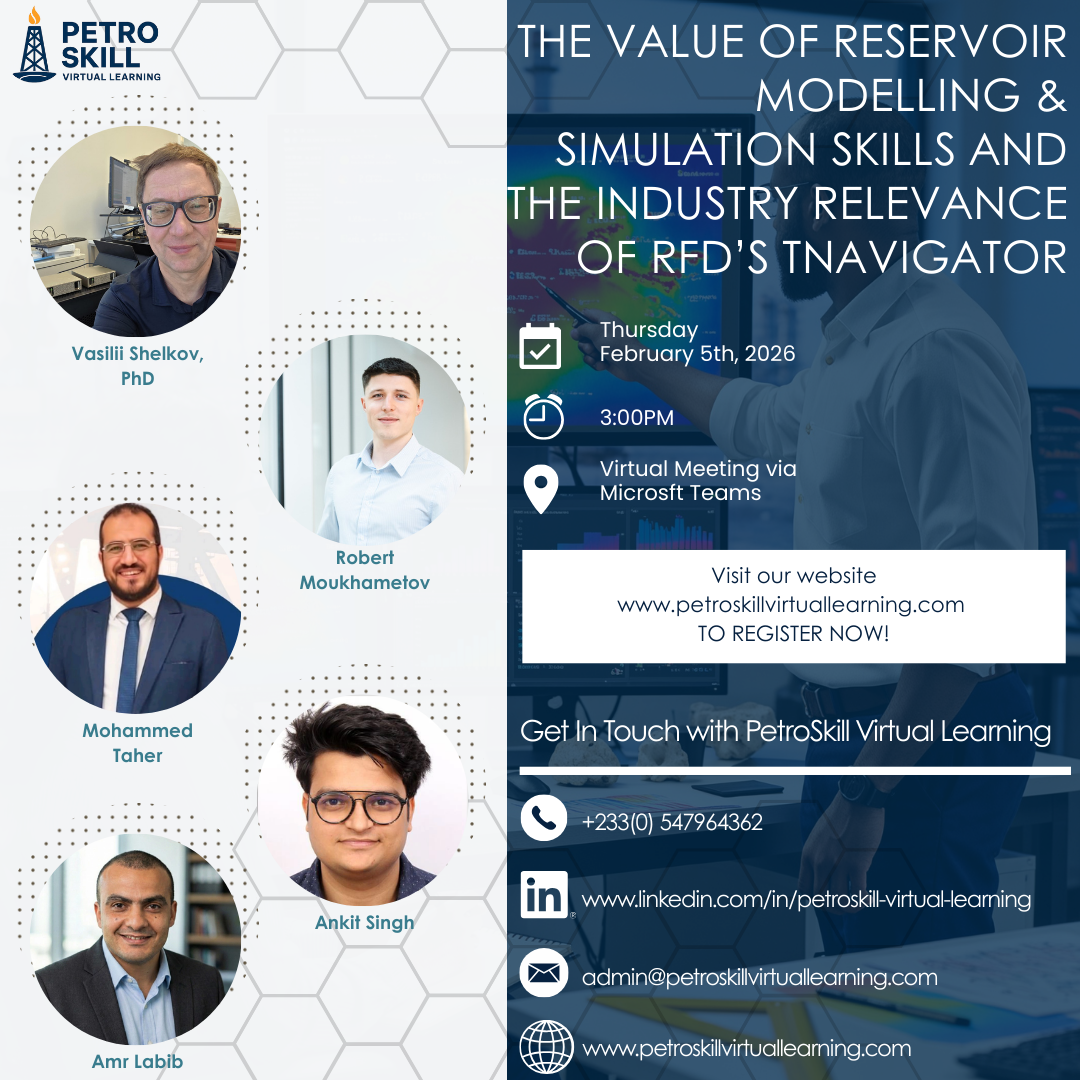
PetroSkill Virtual Learning recently hosted a high-impact technical seminar titled “The Value of Reservoir Modelling & Simulation Skills and the Industry Relevance of RFD’s tNavigator.” The event brought together students, early-career engineers, and industry professionals to explore why reservoir modelling and simulation skills remain essential in modern subsurface engineering and how industry-proven tools like RFD’s tNavigator enable effective, real-world decision-making.
The seminar was designed around a clear objective: to connect fundamental modelling competence with practical industry application, highlighting how engineers can move beyond software usage to deliver tangible value in field development, production optimization, and subsurface evaluation.
Fully Coupled Geomechanics in Action – Dr. Vasilii Shelkov
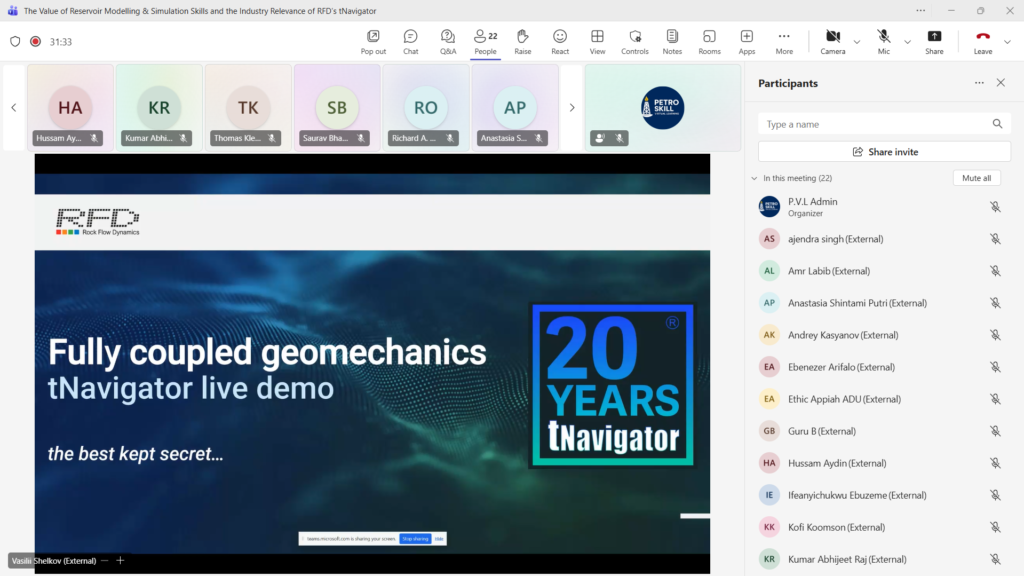
As part of the seminar theme, Dr. Vasilii Shelkov, Co-Founder and CEO of Rock Flow Dynamics (RFD), chaired the session and delivered a flagship technical presentation aligned with the value of advanced modelling skills in today’s industry.
Dr. Shelkov presented a live demonstration of fully coupled geomechanics using the SPE10 model, clearly illustrating how geomechanics is integrated into reservoir simulation workflows within tNavigator. His session demonstrated why modern reservoir modelling is no longer limited to flow simulation alone, but increasingly requires stress–flow coupling, numerical efficiency, and integrated physics to improve prediction accuracy and reduce subsurface risk.
This presentation strongly reinforced the seminar’s core message: advanced simulation skills, when paired with high-performance tools, significantly enhance engineering decision-making.
The Industry Relevance of RFD’s tNavigator – Mohamed Taher
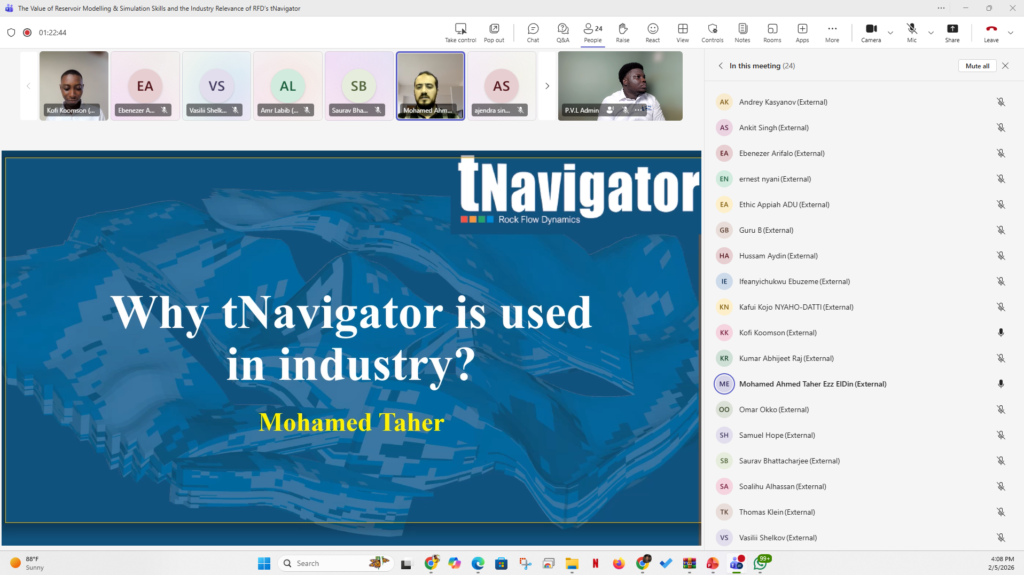
Addressing the core theme of “The Industry Relevance of RFD’s tNavigator,” Mohamed Taher delivered a practical, industry-grounded session explaining why tNavigator has become a preferred reservoir simulation platform across operators.
Drawing directly from the workflows highlighted in his slides, Mohamed emphasized that tNavigator’s value lies not only in speed, but in its fully integrated, end-to-end reservoir modelling environment. He highlighted how engineers can move seamlessly from model building and initialization to history matching, forecasting, and development optimization within a single platform.
Key industry-relevant points discussed included:
- High-performance simulation that significantly reduces model run time, enabling faster decision cycles
- Integrated physics and workflows, minimizing the need for multiple disconnected tools
- Robust history matching and uncertainty handling, supporting reliable forecasting
- Strong applicability to field development planning, production optimization, and asset management
By tying software capability directly to real asset decisions, Mohamed reinforced a central message of the seminar: reservoir modelling tools only deliver value when they enable engineers to make faster, better, and more confident decisions.
What Students Should Focus on When Learning Simulation Tools – Robert Moukhametov
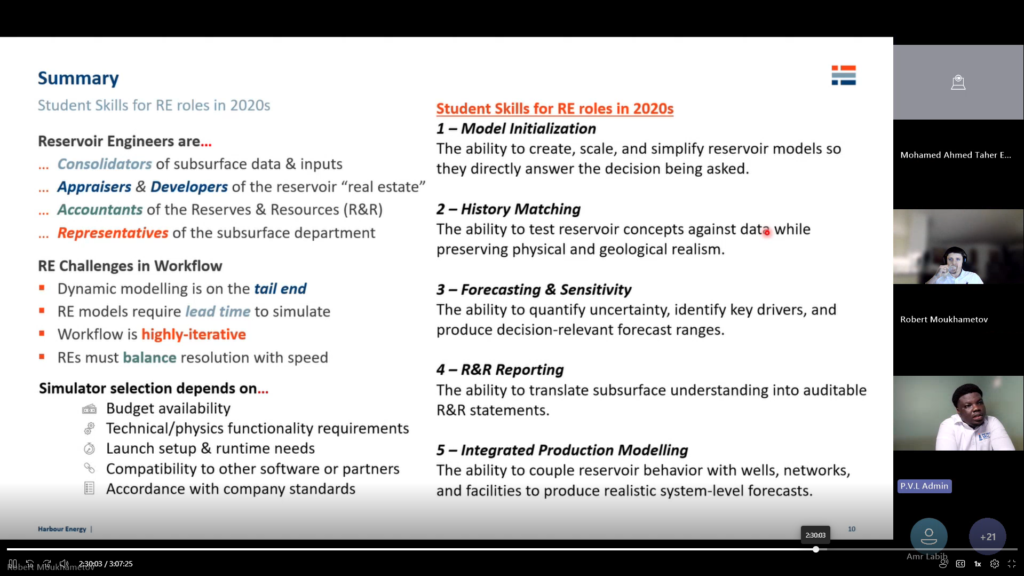
Building on the theme of the value of reservoir modelling and simulation skills, Robert Moukhametov focused his session on how students and early-career engineers should approach learning simulation tools in an industry-relevant way.
Based on the key messages in his presentation, Robert stressed that software proficiency alone is not enough. Instead, he encouraged participants to prioritize engineering thinking and subsurface understanding before focusing on advanced tool features.
His key guidance included:
- Developing a strong understanding of reservoir fundamentals, flow behavior, and model assumptions
- Learning why models behave the way they do, not just how to run them
- Using simulation as a decision-support tool, not a goal in itself
- Understanding how models evolve from early concept studies to mature asset management and CCS applications
Robert also shared insights from his experience across multiple assets and CCS projects, illustrating how simulation tools like tNavigator are used differently depending on project maturity, uncertainty, and decision context.
His session strongly reinforced the seminar’s overarching message: the real value of reservoir modelling skills lies in interpretation, judgment, and application not button-clicking.
Panel Discussion: Developing Reservoir Modelling & Simulation Competence – Ankit Singh & Amr Labib

During the panel discussion, Ankit Singh and Amr Labib addressed several key questions around learning reservoir simulation, interpreting results, and managing uncertainty. Across all questions, a consistent message emerged: strong fundamentals and background understanding are more important than any specific simulation tool.
When asked what engineers should focus on early in their careers, both panelists emphasized the need to first master core reservoir engineering concepts, including rock and fluid properties, flow mechanisms, material balance, pressure–production relationships, and reservoir drive mechanisms. They noted that simulation tools become truly valuable only when engineers understand the physics and assumptions behind the models.
Addressing common gaps, the panel highlighted that many engineers can run simulations but struggle to interpret or trust their results. This often stems from limited understanding of input data quality, model assumptions, boundary conditions, and uncertainty sources. Without this foundation, simulation outputs are treated as black boxes rather than tools to support engineering judgment.
On uncertainty, Ankit and Amr agreed that subsurface uncertainties particularly geology, fluid contacts, SCAL, and dynamic data such as pressures and production history tend to dominate simulation outcomes. Rather than attempting to reduce all uncertainties equally, they advised teams to prioritize uncertainties that directly impact key decisions, such as field development planning, reserves estimation, and recovery strategy selection.
Overall, the panel reinforced that reservoir simulation is a decision-support tool, and its effectiveness depends on an engineer’s ability to connect model behavior back to fundamental reservoir concepts, apply critical thinking, and make informed, defensible decisions.
Reinforcing PetroSkill Virtual Learning’s Mission
“The Value of Reservoir Modelling & Simulation Skills and the Industry Relevance of RFD’s tNavigator” was more than a technical seminar, it was a reflection of PetroSkill Virtual Learning’s mission to bridge the gap between academia and industry.
Through expert-led sessions, live demonstrations, and open discussion, participants gained a clearer understanding of:
- Why modelling and simulation skills remain critical
- How industry-leading tools like tNavigator are applied in practice
- What it takes to build long-term relevance as a reservoir engineer
We extend our sincere appreciation to all our speakers for their time, expertise, and commitment to mentoring the next generation of subsurface professionals.
Stay connected with PetroSkill Virtual Learning for upcoming seminars, training programs, and industry-focused learning opportunities.
Watch Seminar Highlights Online
For those who missed the live session, or would like to revisit key insights, short highlight snippets from the seminar are available on our LinkedIn and YouTube pages. These clips feature moments from the technical presentations, live demonstrations, and panel discussion, offering a glimpse into the value of reservoir modelling and simulation skills and the real-world application of RFD’s tNavigator. We encourage you to follow PetroSkill Virtual Learning on both platforms to stay updated on future events, technical content, and full seminar releases.